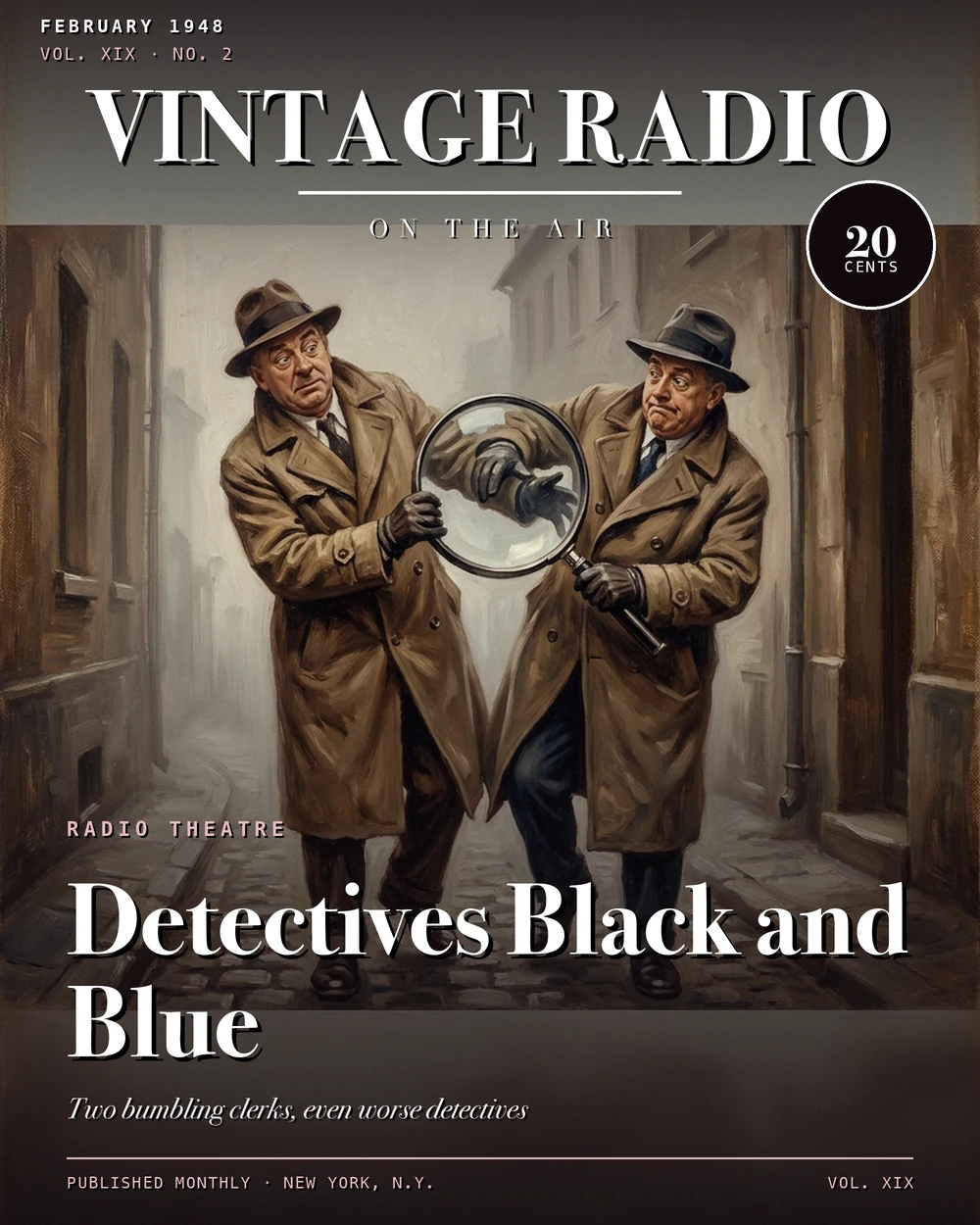
Detectives Black and Blue
Two Clerks, One Bad Idea
The premise of Detectives Black and Blue is almost too simple to work — and that was probably the point. Jim Black and Frank Blue were shipping clerks in a Duluth market whose restless ambition outpaced their common sense by a considerable margin. Hungry for something more exciting than counting inventory, they enrolled in a correspondence course in criminology, completed it, and promptly hung out a shingle. Promotional descriptions billed them plainly as "the world's dumbest and luckiest detectives," which is as honest a summary as any radio serial ever offered about itself. Their motto — "Detec-a-tives Black and Blue, good men tried and true" — had the ring of men who believed in themselves rather more than the evidence warranted.
The series ran from 1932 to 1935 in transcribed syndication, with 333 fifteen-minute episodes produced for daily broadcast. Folgers Coffee was the primary sponsor throughout the run. No writer, director, or producer credits have been identified in any surviving source, and the cast remains unknown.
How It Sounded
Production was, by any honest measure, primitive. There were virtually no sound effects. Every chase, every confrontation, every moment of accidental triumph was carried entirely through dialogue. For a comedy about detectives crashing through cases with maximum incompetence, that approach put an enormous amount of weight on the writing and the performers. The show's premise was that Black and Blue had, through their bumbling, set the art of detection back roughly forty years. Whether that joke landed consistently across 333 episodes is impossible to say now, since only five or six are known to survive. The audio quality of what does remain has been described as exceptional relative to other transcription recordings from the era, which means at least a small window into the show is still open.
The surviving episode titles hint at the serial's texture: the opening installment concerned shortages in a store's sugar count, while later episodes sent Black and Blue into a multi-part case involving a character named Olga Ragloff, stolen bonds, and an old flour mill. That arc spanning at least episodes 23 and 24 suggests the show worked with continuing story threads rather than purely self-contained plots — a reasonable choice for a daily quarter-hour format that needed to keep an audience coming back.
Where It Fit
Radio historian Tim Gracyk has placed Detectives Black and Blue alongside programs like The Adventures of Si and Elmer as an example of the wave of canned comedy-serial programs that emerged in early 1930s transcription syndication, trying to ride the commercial momentum of Amos 'n' Andy. That context helps explain both the format and the approach. Transcribed syndication in this period meant the show was recorded to disc and distributed to local stations rather than broadcast live from a network, which made it inexpensive to produce and easy to move around the dial. The stripped-down sound design — or near-total absence of one — fits that low-overhead model perfectly.
The show didn't survive the decade, and almost nothing of the people who made it has come down to us by name. What remains is the idea: two thoroughly ordinary men who convinced themselves they were detectives, and 333 episodes of evidence to the contrary.